 VipNews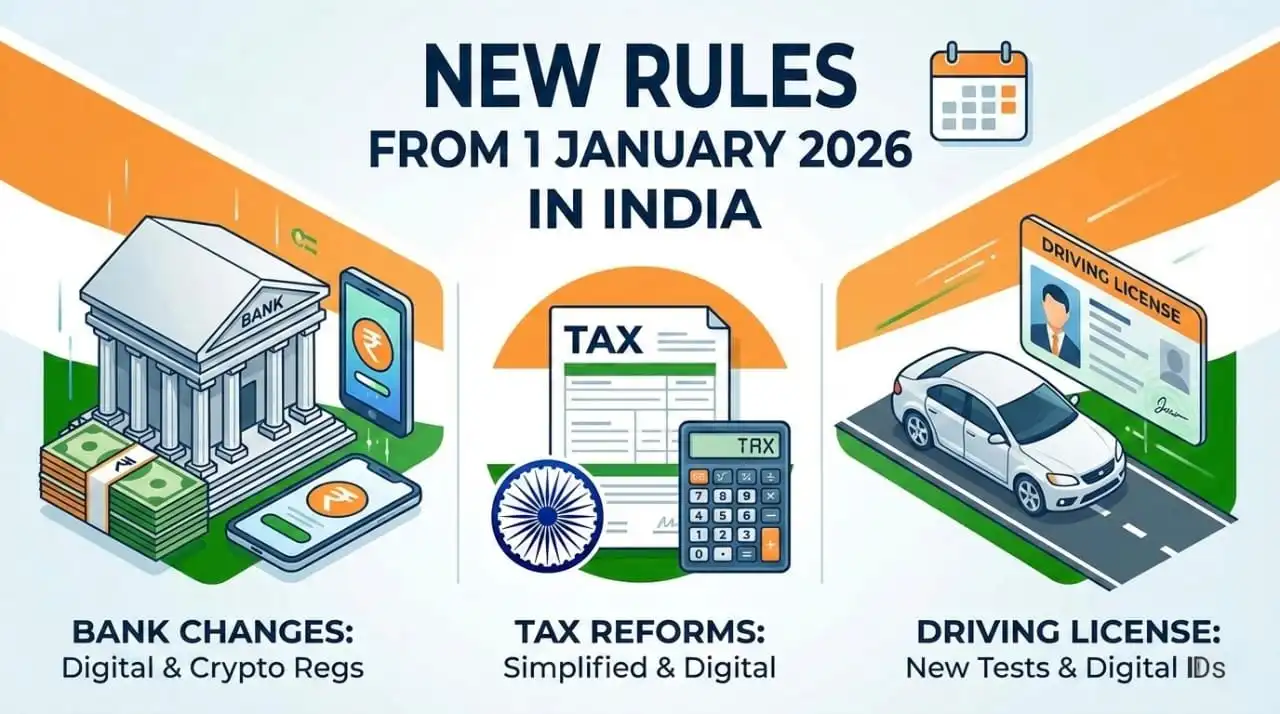
India is set to witness major regulatory changes from 1 January 2026, affecting everyday life. These new rules 1 January 2026 India will directly impact banking services, income tax compliance, and driving license regulations. According to recent government announcements covered in our Latest India News, these changes aim to improve transparency and digital compliance across the country.
Whether you are a salaried employee, business owner, or vehicle owner, understanding these changes early can help you avoid penalties and stay legally compliant.
Let’s break down all the important new rules 1 January 2026 India, explained in simple language.

🏦 Banking Rule Changes From 1 January 2026
🔹 Mandatory Aadhaar–PAN Linking for All Bank Accounts
From 1 January 2026 in India, all active bank accounts must be linked with Aadhaar and PAN. Accounts without proper linkage may face:
-
Transaction restrictions
-
Freezing of debit services
-
Temporary suspension
This rule aims to reduce financial fraud and benami transactions.
🔹 New KYC Renewal Timeline
Banks will introduce a shorter KYC renewal cycle:
-
High-risk customers: Every 2 years
-
Medium-risk: Every 5 years
-
Low-risk: Every 10 years
Failure to update KYC may lead to account limitations.
🔹 Digital Nominee System
A new digital nominee update system will allow customers to:
-
Add or modify nominees online
-
Avoid branch visits
-
Reduce disputes after death
This is one of the most user-friendly new rules 1 January 2026 India.
💰 Income Tax New Rules From 1 January 2026
🔹 Real-Time Tax Data Tracking
Income Tax Department will use advanced AI systems to track:
-
Bank interest
-
Stock market gains
-
Crypto transactions
-
High-value purchases
Mismatch between income and spending may trigger automatic notices.
🔹 New Standard Deduction Structure
The government plans to revise the standard deduction limits to provide relief to middle-class taxpayers under the new tax regime.
🔹 Faster Refund Processing
Tax refunds will be processed within 7–10 working days, provided:
-
Aadhaar is linked
-
Bank account is pre-validated
-
ITR is error-free
This is a welcome change under the new rules 1 January 2026 India. According to updates released by the Income Tax Department, enhanced data analytics will be used to monitor high-value transactions and tax compliance.
🚗 Driving License & Traffic Rules From 1 January 2026
🔹 Digital Driving License Mandatory
Physical driving licenses will be phased out gradually. Drivers must:
-
Carry digital DL via DigiLocker or mParivahan
-
Ensure details are updated
Traffic police will accept digital-only licenses.
🔹 Stricter Traffic Fines
Violations like:
-
Drunk driving
-
Overspeeding
-
Signal jumping
will attract higher fines and instant e-challans.
Repeat offenders may face license suspension.
🔹 Mandatory Driving Test for License Renewal
Drivers renewing licenses after 50 years of age must:
-
Clear a basic driving test
-
Pass vision and reflex checks
This rule improves road safety significantly.
🧾 Other Important New Rules 1 January 2026 India
🔹 SIM Card & Mobile Verification
SIM cards will require:
-
Biometric verification
-
Aadhaar-based authentication
Unverified numbers may be disconnected.
🔹 LPG & Subsidy Changes
Subsidies will be:
-
Directly linked to Aadhaar
-
Auto-credited to bank accounts
-
Removed for ineligible users
🔹 Government Services Fully Digital
Services like:
-
Ration cards
-
Pension schemes
-
Scholarships
will move to 100% online platforms.
🤔 Why These New Rules Matter?
The new rules 1 January 2026 India are designed to:
-
Improve transparency
-
Reduce corruption
-
Increase digital adoption
-
Strengthen citizen safety
Ignoring these changes could lead to financial loss, penalties, or service disruption.
✅ What You Should Do Before 1 January 2026
✔ Link Aadhaar with PAN and bank accounts
✔ Update KYC details
✔ Switch to digital driving license
✔ File accurate income tax returns
✔ Follow traffic rules strictly
Preparation is the key to staying stress-free.
🔍 Sector-wise Impact Analysis of New Rules 1 January 2026 India
The new rules from 1 January 2026 in India will not affect everyone in the same way. Different groups—students, salaried employees, senior citizens, business owners, and vehicle owners—will experience different levels of impact. Understanding how these rules affect you personally is crucial.
👨💼 Impact on Salaried Employees
Salaried individuals will see the maximum impact of the new rules from 1 January 2026 in India, especially in taxation and banking.
Key Changes You Should Know:
-
Salary credits will be monitored more closely via linked PAN–Aadhaar data
-
Any mismatch between declared income and bank deposits may trigger scrutiny
-
Investment proofs like ELSS, PPF, NPS, and insurance premiums must be accurate
💡 Tip:
Ensure your Form 16, bank statements, and AIS (Annual Information Statement) are aligned before filing returns.
👴 Impact on Senior Citizens
Senior citizens will benefit from some changes, but compliance becomes equally important.
What Changes for Seniors?
-
Pension accounts must have updated KYC
-
Nominee details become mandatory for savings and FD accounts
-
Digital verification may replace physical visits
While these steps improve security, elderly citizens should complete updates early to avoid last-minute issues.
🧑💻 Impact on Business Owners & Freelancers
If you’re self-employed, the new rules from 1 January 2026 in India will require stricter discipline.
Major Impacts:
-
Business bank accounts will face closer transaction monitoring
-
GST-linked income data may be cross-verified with income tax filings
-
Digital invoices and UPI transactions may fall under automated tracking
⚠️ Risk:
Unreported cash income could lead to instant notices under the new system.
🚘 Vehicle Owners: What Will Change Practically?
For millions of Indians, driving-related changes will be the most visible impact of the new rules from 1 January 2026 in India.
Real-Life Scenarios:
-
You forget your physical license → no issue if digital DL is available
-
Repeated traffic violations → license suspension possible
-
Senior drivers → renewal requires fitness checks
This shift is meant to reduce road accidents, not harass drivers.
📊 Why Government Is Introducing These New Rules in 2026
Many people ask why so many rules at once?
Government Objectives:
-
Increase transparency
-
Reduce black money circulation
-
Improve road safety
-
Speed up digital governance
-
Minimize manual corruption
The new rules 1 January 2026 India align with India’s long-term vision of becoming a digitally empowered economy.
🧠 Myths vs Facts About New Rules 1 January 2026 India
❌ Myth 1: All bank accounts will be frozen
✅ Fact: Only non-compliant or KYC-failed accounts may face restrictions.
❌ Myth 2: Cash transactions will be banned
✅ Fact: Cash is legal, but large unexplained deposits may attract attention.
❌ Myth 3: Old driving licenses will become invalid overnight
✅ Fact: Transition will be gradual, with sufficient time given.
🛡️ How to Stay 100% Safe & Compliant (Checklist)
Before 1 January 2026, complete this checklist:
✔ Aadhaar linked with PAN
✔ Bank KYC updated
✔ Mobile number linked with Aadhaar
✔ Digital driving license downloaded
✔ Income tax returns filed correctly
✔ Nominee details updated
Following this checklist ensures zero stress under the new rules from 1 January 2026 in India.
🏁 Conclusion
The new rules 1 January 2026 India are not just legal updates—they are lifestyle changes. Citizens who stay informed and compliant will benefit the most, while those ignoring updates may face inconvenience.
📌 Stay updated with vipnews247.com for accurate, timely, and simplified explanations of government rules, jobs, and breaking news.